
What Financial Science Has Taught Us About Investing

For much of the history of investing, the conventional approach to building wealth was relatively straightforward: identify good companies, buy their shares at attractive prices and sell them when circumstances change.
It sounds sensible. After all, if you can consistently identify the companies that will perform best, surely you should achieve superior investment returns?
The problem, of course, is that consistently identifying those companies in advance has proved extraordinarily difficult. We have previously shared articles showing only 4% of listed US stocks accounted for the entire net wealth creation - https://www.loricapartners.com.au/insights/you-dont-need-to-pick-the-winners-but-you-do-need-to-own-them
Over the past 70 years, academic research has fundamentally changed our understanding of how financial markets work, what drives investment returns and how portfolios should be constructed.
At Lorica Partners, this research forms the foundation of our investment philosophy.
The first breakthrough: Understanding risk
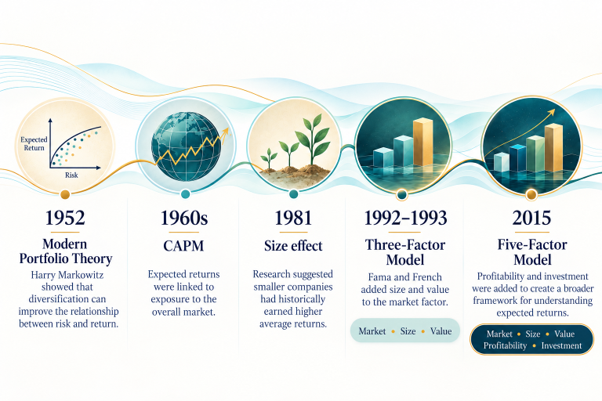
In 1952, economist Harry Markowitz published research demonstrating how diversification could improve the relationship between risk and return within an investment portfolio.
His work established an important principle: the risk of a portfolio depends not simply on the individual investments it contains, but on how those investments behave in relation to one another.
This laid the foundation for Modern Portfolio Theory and changed how investors thought about portfolio construction.
During the 1960s, researchers built on this work through the Capital Asset Pricing Model (CAPM), which suggested that an investment's expected return was largely determined by its sensitivity to movements in the overall sharemarket.
The underlying principle was important: investors should expect to be compensated for taking certain risks.
However, when researchers examined actual sharemarket returns, they found that exposure to the overall market did not adequately explain why some groups of companies consistently generated different returns from others.
There appeared to be more to the story.
The discovery that changed investing
In 1981, academic Rolf Banz published research suggesting that smaller companies had historically generated higher average returns than larger companies, even after accounting for their exposure to the overall market.
A decade later, Eugene Fama and Kenneth French took the research further.
Their landmark work in 1992 and 1993 demonstrated that much of the variation in historical sharemarket returns could be explained by three broad factors:
Market: Shares have higher expected returns than risk-free investments.
Size: Smaller companies have historically delivered higher average returns than larger companies.
Value: Companies trading at lower prices relative to their underlying fundamentals have historically delivered higher average returns than more expensive companies.
This became known as the Fama-French Three-Factor Model.
The significance was considerable.
Rather than trying to predict which individual companies would outperform, investors could identify characteristics shared by thousands of companies that were associated with differences in expected returns.
And the research didn't stop there.
Subsequent research identified profitability as another important characteristic. In 2015, Fama and French expanded their model to include profitability and investment.
Research had demonstrated that companies with stronger profitability tended to generate higher average returns, while companies investing more conservatively in their businesses had also historically generated higher returns than those expanding their assets aggressively.
The result was a more sophisticated understanding of what influences expected investment returns.
The important distinction is that these factors help us understand expected returns. They do not allow us to predict future returns with certainty.
Why should these characteristics influence investment returns?
Understanding that certain types of companies have historically generated higher returns is useful. Understanding why is arguably more important.
Consider two companies generating similar profits. If investors are prepared to pay $100 for shares in one company but only $60 for comparable shares in the other, the lower-priced company may offer a higher expected return, assuming their prospects are otherwise similar.
Of course, there may be good reasons for the difference in price. One company might have stronger growth prospects, while the other faces greater uncertainty.
This illustrates an important principle: the price you pay for an investment matters, not simply the quality of the company you are buying.
A wonderful business can be a poor investment if too much is paid for it. Equally, a less fashionable business purchased at a sufficiently attractive price can deliver excellent returns.
The relationship between company size, profitability and expected returns is more complex, but the underlying research provides a framework for understanding how these characteristics interact with market prices.
Not every historical return premium is necessarily compensation for risk. Investor behaviour, market frictions and other factors also play a role, and academics continue to debate the explanations.
The important point is that we can use evidence to develop a more systematic approach to investing rather than relying on opinions about which companies or markets will perform best.
Why do we call this Financial Science?
In his influential book What Is This Thing Called Science?, Australian philosopher Dr Alan Chalmers explores how scientific knowledge develops, arguing that science is not simply about establishing absolute truths, but about developing theories, testing them against evidence and refining our understanding as new information emerges.
Financial science follows this same process.
Researchers develop models to explain investment returns, test them using decades of market data and refine those models as new evidence emerges. The significance of this research has been recognised at the highest academic level, with pioneers including Harry Markowitz and Eugene Fama receiving Nobel Prizes in Economic Sciences for their contributions to our understanding of financial markets.
The work of Markowitz and Fama directly influences how we invest at Lorica Partners. Markowitz demonstrated why diversification is so important, which is why our portfolios typically hold thousands of companies across global markets rather than concentrating on a small number of investments. Fama's research into market efficiency helps explain why we don't attempt to predict market movements or consistently identify winning companies. And his subsequent work with Kenneth French provides the foundation for systematically favouring companies with characteristics associated with higher expected returns, including smaller size, lower relative prices and stronger profitability.
What does this mean for investors?
For investors, the value of financial science isn't that it provides certainty, but that it offers a more reliable foundation for decisions than intuition, speculation or predictions about the future.
Perhaps the most valuable insight from this research is that not all investment risks are equally rewarded.
Owning a single company exposes an investor to risks associated with that business. Its management might make poor decisions, competitors might emerge or its products might become obsolete. If you were a shareholder in Cochlear in April 2026, you are aware these variables can cause the price of a stock to drop 40% in one day.
These risks can be substantially reduced through diversification, without necessarily sacrificing expected returns.
By contrast, certain broader risks and company characteristics have historically been associated with higher expected returns.
This leads to a fundamentally different approach to portfolio construction.
Rather than concentrating wealth in a handful of companies we believe will perform well, we can own thousands of companies across global markets while deliberately placing greater emphasis on those with characteristics associated with higher expected returns.
Importantly, these relationships do not operate consistently over short periods.
Large companies can outperform small companies for years. Expensive growth companies (like the Magnificent 7) can outperform value companies for extended periods. Even highly profitable businesses can disappoint investors.
These periods can test investors' confidence in a strategy, particularly when another approach appears to be performing better.
However, constantly changing investment strategies in response to recent performance is unlikely to be a reliable path to building long-term wealth.
This is why patience, diversification and discipline remain so important.

Markets don't need to be perfect
Another important contribution to financial science came from Eugene Fama's research into market efficiency, for which he won the Nobel Prize for Economic Sciences in 2013.
The central idea is that financial markets are highly effective at incorporating available information into security prices.
Every day, millions of investors, analysts and institutions assess companies, economic conditions and future prospects. Their collective decisions influence the prices at which securities trade.
This doesn't mean market prices are always correct. Investors can become overly optimistic or pessimistic, and prices can move substantially away from what later appears reasonable.
However, identifying these mistakes consistently and before other investors recognise them is extraordinarily difficult.
The distinction matters.
We don't need to believe markets are perfectly efficient. We simply need to recognise that they are sufficiently competitive to make consistently outsmarting other investors very difficult.
This is one of the reasons we don't believe that successful investing should depend on predicting interest rates, anticipating recessions or identifying which companies will outperform next year.
Fortunately, it doesn't have to.
Turning research into an investment philosophy
There is an important distinction between understanding financial science and successfully applying it.
Academic research provides a framework, not a formula for guaranteed returns. Some apparent relationships disappear over time, while others prove too expensive or difficult to capture in real portfolios.
At Lorica Partners, we therefore look for investment strategies supported by credible economic reasoning, extensive historical evidence and practical implementation.
Our approach starts with broad global diversification. We then seek to improve expected returns by systematically increasing exposure to characteristics such as company size, relative price and profitability.
But portfolio construction is only part of the equation.
One of the most important lessons from financial science is that uncertainty cannot be eliminated from investing. Indeed, the expectation of earning a return is closely connected to accepting uncertainty about the future.
Market downturns are inevitable. Economic forecasts will be wrong. Investment strategies will experience periods of disappointing performance.
The goal is not to eliminate these experiences, but to construct portfolios that can withstand them without forcing investors to abandon their long-term plans.
This is why we place considerable emphasis on aligning investment portfolios with each client's financial objectives, time horizons and capacity to take risk.
Just as importantly, we focus on those things investors can control: diversification, investment costs, taxation, portfolio construction, rebalancing and behaviour.
We cannot control what markets do next. Fortunately, a successful long-term investment strategy should not depend on being able to predict it.
Putting financial science to work
One of the investment managers we have worked with for many years is Dimensional Fund Advisors, founded in 1981 by David Booth and Rex Sinquefield.
Dimensional was an early pioneer in translating academic financial research into practical investment strategies. Its close association with researchers including Eugene Fama and Kenneth French (who sit on their Investment Committee, together with two other Nobel laureates) has helped shape an approach that combines broad diversification with systematic exposure to recognised drivers of expected returns.
We use Dimensional in client portfolios alongside other investment managers whose strategies are consistent with our philosophy, continually assessing the research, implementation, costs and suitability for our clients.
For us, the investment philosophy comes first. The investment managers are simply one means of implementing it.
The bigger picture
Financial science has not discovered how to predict the future. Markets remain uncertain, individual companies will surprise us, and investment returns will never arrive in a straight line.
What research has given us is something arguably more valuable: a better understanding of how markets work and a disciplined framework for making investment decisions.
Our belief is that successful investing is not about having an opinion on everything, identifying the next winning company or anticipating every market downturn.
It is about understanding which risks are worth taking, diversifying those risks intelligently and allowing time for the evidence to work in your favour.
Ultimately, the purpose of investing is not simply to maximise returns. It is to provide the financial resources and confidence to live the life you want.
That's the foundation of our investment philosophy.
Author: Rick Walker
Source: we used an article by IFA as inspiration for writing our own history of financial science - https://www.ifa.com/articles/from_factors_dimensions_financial_science_changed_understand_stock_returns