
Financial Market Update to 30 September 2026

Sharemarkets resilient but tougher bond markets
The September quarter provided another useful reminder that financial markets and economic headlines do not always move together.
The conflict in the Middle East intensified again, oil prices rose sharply, inflation remained stubbornly above central bank targets and bond yields moved higher. In Australia, the Reserve Bank finished the quarter by increasing interest rates for the fourth time this year.
Despite this, global sharemarkets remained resilient.
Artificial intelligence investment continued to support economic growth and company earnings, particularly in the United States and parts of Asia. Corporate profitability remained strong and, importantly, the global economy proved more resilient than many investors had expected.
The weakest part of financial markets was not equities but bonds.
Interest rates moved back to centre stage
For much of the past two years, the markets had expected inflation to gradually fall and central banks to eventually reduce interest rates.
During the September quarter, that assumption was challenged.
Government bond yields rose sharply across most developed markets as investors reassessed how quickly inflation would return to target and whether central banks might need to increase interest rates further.
In the United States, the 10-year Treasury yield rose by approximately 0.8% during the quarter and moved above 5% late in September - its highest level in almost two decades. Bond yields also rose in Europe and Japan.
As bond yields rise, existing bond prices fall. Longer-duration bonds are particularly sensitive because investors are locking in their interest payments for longer.
There is an important distinction, however, between a poor period for bond returns and bonds becoming less attractive investments.
Higher yields mean investors buying bonds today are receiving considerably more income than they were several years ago. Vanguard's latest long-term modelling, for example, estimates prospective returns of around 4.6% to 5.6% for Australian bonds and 5.1% to 6.1% for hedged global bonds over the next decade. These are forecasts rather than guarantees, but they illustrate how dramatically the starting point for defensive assets has improved.
The price investors have paid for getting to those higher yields has been uncomfortable given we started from a historically low interest rate base just four years ago.
Inflation proved harder to subdue
The underlying problem is inflation, which remains higher than most central bank targets. Higher energy prices have added to this.
Oil prices were volatile during the quarter as developments in the Middle East repeatedly changed expectations for global supply. US oil prices traded between approximately US$67 and US$107 per barrel during the quarter.
This matters well beyond what motorists pay at the petrol station, because energy feeds into transport, manufacturing, agriculture, air travel and ultimately the price of a very large number of goods and services.
Australia moved against the direction investors had expected
At the beginning of 2026, relatively few investors expected the Reserve Bank to increase interest rates four times during the year. Yet on 29 September the RBA increased the cash rate by another 0.25%, taking it to 4.60%, which is the highest level in 15 years.
The reason is simply inflation remains too high.
The latest ABS figures showed headline inflation increasing to 4.0% in the year to August, while trimmed mean inflation (which removes some of the more volatile price movements) remained at 3.6%.
The RBA also remains concerned that Australia's economy has less spare productive capacity than previously thought. Our weak productivity growth is important here because if the economy cannot produce significantly more goods and services without generating additional wage and price pressures, economic growth can translate into inflation relatively quickly as businesses facing higher costs pass those costs onto customers.
This does not necessarily mean there will be many more rate increases. NAB, for example, currently expects the RBA to remain on hold at 4.60%. It does mean that hopes for rapid interest-rate cuts have again been pushed further into the future.
Higher rates are increasingly affecting Australian households
The impact of four interest rate increases is becoming more visible as household budgets are squeezed by the combination of higher mortgage repayments and higher prices for essential goods and services. Housing turnover has slowed and borrowing capacity has fallen.
Australian residential property prices have now declined for six consecutive months. Sydney prices fell approximately 1.4% during September and are almost 9% below their February peak. National dwelling values are around 5% below their recent peak.
The September rate increase will place additional pressure on borrowers.
Artificial intelligence continued to support economic growth
Against this less comfortable economic backdrop, artificial intelligence (AI) remained the dominant positive force in global equity markets.
The enormous investment in data centres, semiconductors, memory, servers, networking equipment and electricity generation continued. Over US$ 1 trillion is expected to be spent in 2026, with most of this in the U.S. This spending is now sufficiently large to materially affect economic growth.
Some businesses supplying AI infrastructure will earn extraordinary returns. Others will face increasing competition and falling margins. Established companies will use AI to improve productivity and profitability. Others may find their existing business models disrupted.
J.P. Morgan describes this as the question of who ultimately captures the largest "slice of the pie". We expect AI will expand the economic pie. It is considerably less obvious which companies will be victorious. That uncertainty is another argument for diversification.
US corporate earnings have continued to be strong, particularly among technology-related businesses.
This helps explain an apparent contradiction:
interest rates rose, bond yields rose and geopolitical risks increased
yet sharemarkets generally held up.
Companies ultimately derive their value from profits. If earnings continue to grow strongly, sharemarkets can absorb a surprising amount of bad news.
Equity markets were more resilient than bond markets
Global shares finished the September quarter higher overall despite a weaker final month.
US markets recorded a second consecutive positive quarter, supported by strong corporate earnings and continuing enthusiasm around AI-related investment. Emerging markets also benefited from their significant exposure to semiconductor manufacturing and technology infrastructure.
Importantly, the strength in equity markets has occurred while bond yields have increased. That combination cannot continue indefinitely without consequences.
A higher bond yield raises the return investors can earn without taking equity (sharemarket) risk. It also increases the discount rate used to value future company profits, which can place downward pressure on valuations. So far, earnings growth has largely offset that pressure.
Valuations still matter
The US market remains relatively expensive compared with its own history, although strong earnings growth has helped prevent valuation multiples from expanding as dramatically as share prices alone might suggest.
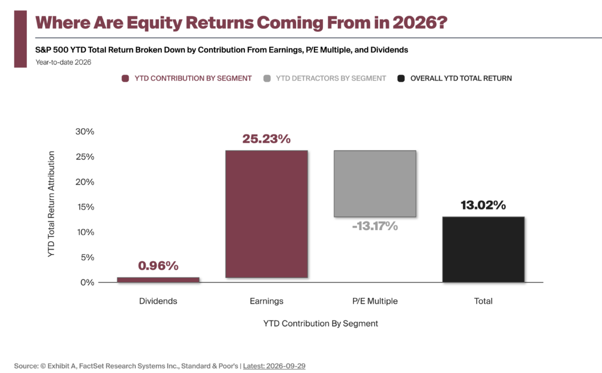
Prices aren’t falling but valuations are because the price earnings (PE) multiples being used to value companies are reducing as this graphic shows:
The next graphic breaks it down further. Only one sector, Consumer Staples, has seen its valuation multiple increase.
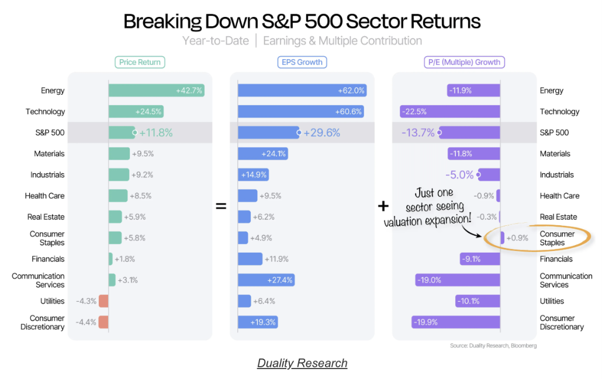
If we look at the Technology sector, prices are up +24.5% for the year to date, but earnings (as measured by Earnings per Share (EPS) Growth) are up +60.6% whilst the PE multiple is down -22.5%.
Nvidia is a good example of a stock where the valuation as measured by the PE multiple is falling:
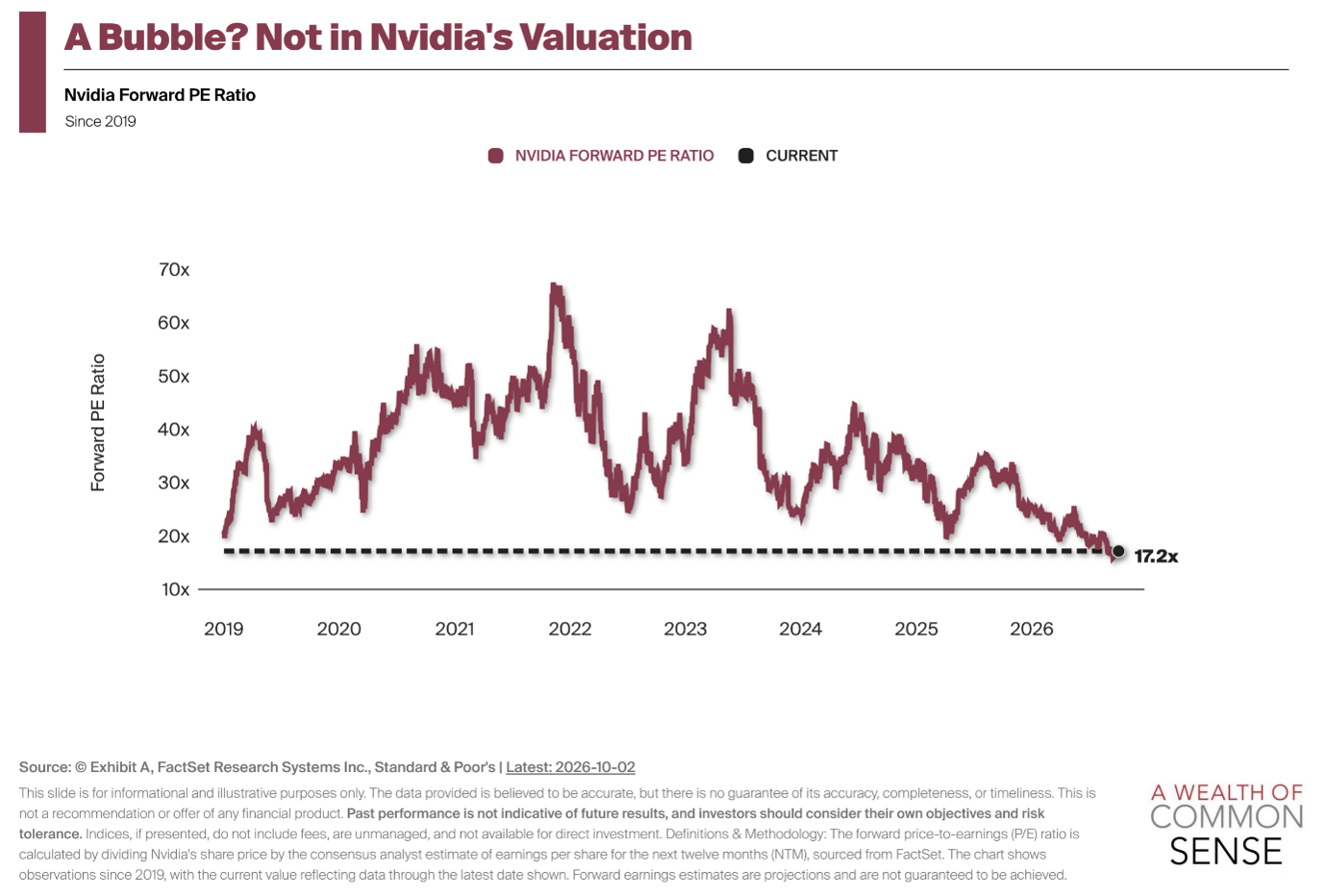
For investors, the key message is that high share prices do not necessarily mean markets are becoming more expensive in valuation terms. If company earnings are growing faster than share prices, valuation multiples can fall even while markets continue to rise. That is broadly what we are seeing in parts of the US market today.
It does not remove the risk of weaker returns or market falls, but it does suggest that recent market strength has been supported by genuine earnings growth rather than simply investors paying ever-higher prices for the same level of profits.
An increasingly expensive government borrowing problem
Another development worth watching is the increasing pressure in government bond markets.
Governments around the world continue to run significant budget deficits while private companies require enormous amounts of capital to finance AI infrastructure, energy investment and other projects.
Investors therefore have an unusually large demand for their money.
When governments want to borrow more, investors can demand higher interest rates to provide that capital.
BlackRock describes this as a competition between government borrowing and the enormous private-sector financing requirements associated with AI. It is one reason longer-term government bond yields have risen even where investors believe central bank interest rates may eventually decline.
For many years investors became accustomed to governments being able to borrow at exceptionally low rates. That world may not return quickly.
Note the bond funds held in most Lorica client portfolios have around 2% exposure to US government bonds and between 10% and 15% exposure to direct sovereign government bonds overall. The majority is invested in investment grade corporate and government-related debt.
What this means for you
The investment environment remains unusual.
Global economic growth has remained stronger than expected by the market. Corporate earnings are healthy and investment in AI infrastructure continues to provide a powerful source of economic demand.
Against that, inflation remains above target, interest rates have moved higher rather than lower, government borrowing is substantial and geopolitical risks remain elevated.
There is no shortage of reasons why markets could fall.
There rarely is.
The problem is that waiting until those risks disappear has historically been a poor investment strategy. Markets generally move before uncertainty has been resolved.
The events of the September quarter therefore reinforce the value of:
maintaining a diversified portfolio
avoiding excessive exposure to whichever part of the market has recently performed best
maintaining sufficient defensive assets to fund medium-term spending requirements
favouring high-quality fixed interest and carefully managing duration risk
rebalancing portfolios when market movements cause allocations to drift materially from their intended targets
remaining invested rather than attempting to predict short-term movements in markets.
The last few years have provided a useful demonstration of how quickly the consensus view can change.
At various times investors have confidently predicted recession, falling inflation, rapid interest rate cuts and the end of the technology boom.
Reality has proved somewhat less cooperative. That is usually the case.
A good investment strategy should therefore not depend upon correctly predicting what happens next.
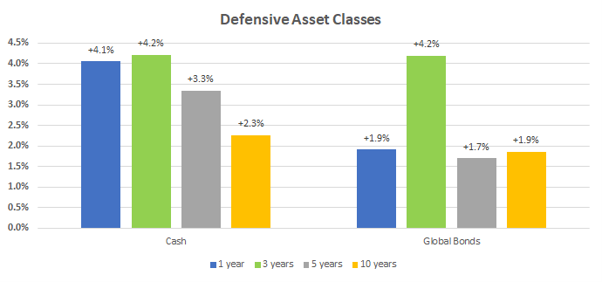
Returns of Major Asset Classes for Periods to 30 September 2026
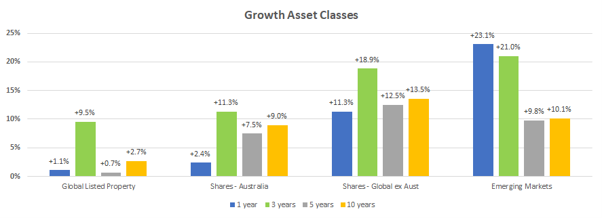
Data sources:
Cash – Bloomberg AusBond Bank Bill Index
Global Bonds – Bloomberg Global Aggregate Bond Index 1–5 Years
Global Listed Property – S&P Global Property Index (net dividends)
Australian Shares – S&P/ASX 300 Index (total return)
Global Shares ex Australia – MSCI All Country World ex Australia Index (net dividends)
Emerging Markets – MSCI Emerging Markets Index (net dividends)
Author: Rick Walker
Source: https://awealthofcommonsense.com/2026/10/the-biggest-risk-everyone-already-knows-about/