
Uncertainty is Not a Problem to be Solved

“It ain’t what you don’t know that gets you into trouble. It’s what you know for sure that just ain’t so” - attributed to Mark Twain (and quoted in the 2015 film “The Big Short”.
You Don’t Need to Know What Happens Next
There is no shortage of things for investors to worry about at present.
Conflict in the Middle East continues to affect energy markets. Oil has recently traded around US$100 a barrel. Inflation remains stubbornly high and interest rates are rising. Meanwhile, enormous amounts of capital are being invested in artificial intelligence, raising perfectly reasonable questions about which companies will benefit and whether current valuations can be sustained.
Whilst none of these issues are trivial, there is an important distinction between “the future is uncertain” and “therefore I should change my investment strategy.”
They are not the same thing.
We have been here before. Just never exactly here. In 10 years’, we will still be feeling uncertainty, but for different reasons.
I went back through some of the articles we have written over recent years to see which lessons were useful at the time and remain useful today.
In late 2018, we wrote that change almost always comes as a surprise. The concerns then included the escalating US/China trade dispute, weakness in the previously dominant FAANG stocks, the Banking Royal Commission and falling house prices weighing heavily on Australian bank shares. If you can clearly recall all of that, your memory is better than mine.
In early 2020 it was COVID (I do remember that). In 2022 it was Russia's invasion of Ukraine, rapidly rising inflation and the fastest interest-rate increases in decades.
In 2023 Silicon Valley Bank collapsed. In 2024 investors worried about record market highs and elections. In 2025 it was tariffs.
The events change. The investment lesson doesn't.
One of the observations we made during COVID was that the future is always uncertain. During stressful periods we simply become much more conscious of that uncertainty.
Think about January 2020. The future was every bit as unknowable then as it was in March 2020. It just didn't feel that way.
That distinction matters.
The problem with waiting for clarity
When the world feels uncertain, waiting can feel prudent.
Why not hold a little more cash until inflation settles? Until the war ends? Until interest rates peak? Until we know whether AI valuations are justified?
Because by the time the answer becomes obvious, markets have normally moved.
Markets are not simply pricing what is happening today. They are continually incorporating what millions of investors collectively expect to happen next. As new information arrives, those expectations change and prices adjust. In that sense, market prices already contain a collective forecast of the future.
Which creates an awkward problem for anyone trying to make a better forecast.
In April last year we looked at the forecasts made by leading investment banks for the US sharemarket. At the start of 2024, the median forecast was for the S&P 500 to rise by just +1.7%. The actual return was +23%. Looking back over five consecutive years, the forecasts repeatedly bore little resemblance to what subsequently occurred as this graphic illustrates:
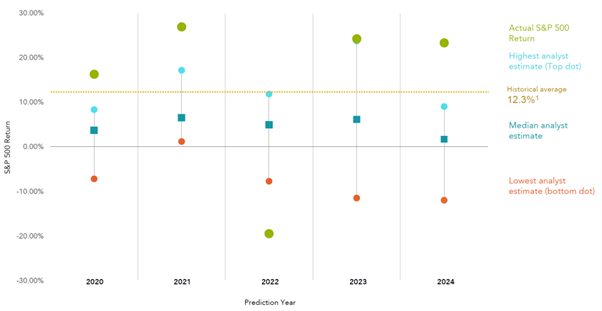
Analyst forecasts versus actual S&P 500 returns, 2020–2024
The lesson isn't that forecasters are foolish. Many are extremely smart people with access to enormous amounts of information. The lesson is that they are trying to predict something that is inherently difficult to predict. And fortunately, investors don't need to.
Volatility doesn't mean something has gone wrong
We sometimes talk about shares delivering an average long-term return as though investors receive something resembling that return each year.
They don't.
Our analysis of nearly 100 years of US market history found that annual returns were within 2% of the long-term average in fewer than 8% of years. In almost half of all years, shares either rose by more than +20% or fell by more than -20%.
Average returns are created from very un-average years.
The same is true within individual years. The Australian sharemarket experienced a fall during every calendar year examined, including years that ultimately produced very strong positive returns. In 2009, for example, the market fell around 15% during the year but finished the year up 38%. Look carefully at the following graphic and the stockmarket falls by at least -10% in almost every calendar year:
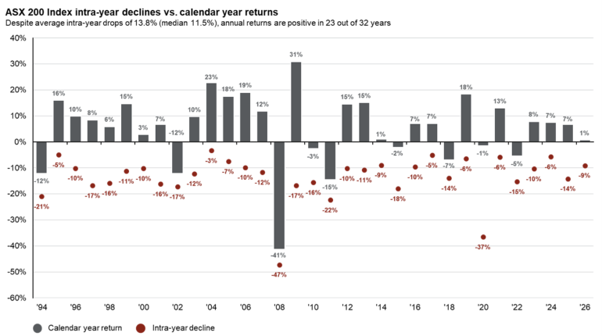
Source: JP Morgan
If every 10% market fall causes you to worry, you will spend a lot of time worrying about something that is entirely normal. This is what investing in shares looks and feels like.
The good days don't politely wait for the bad news to finish
Earlier this year, we highlighted another problem with trying to move in and out of markets. The best and worst trading days tend to occur surprisingly close together.
Vanguard found that 13 of the 20 best global market days since 1980 occurred during years in which the market ultimately produced a negative return. J.P. Morgan similarly found that seven of the ten best days over a 20-year period occurred within 15 days of one of the ten worst days.
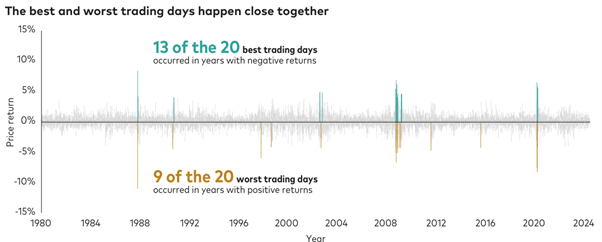
This makes market timing brutally difficult because selling is only the first decision - you then need to decide when to buy again.
And markets have an irritating habit of recovering while the headlines still look terrible.
Volatility is something to plan for, not predict
Market falls feel abnormal when we are living through them. Historically, however, they have been a very normal part of investing. The chart below is a useful reminder:
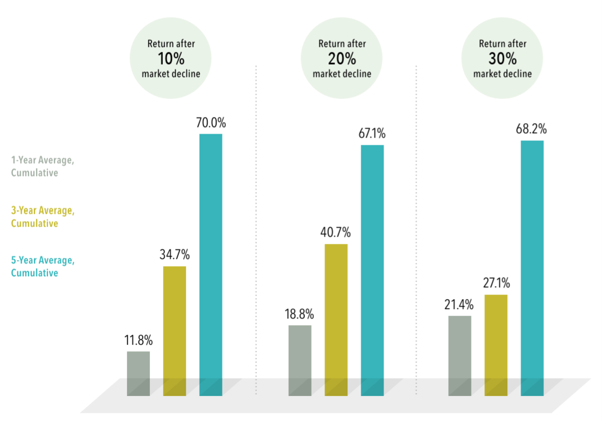
Source: Dimensional Fund Advisors
Looking at US market data from 1926 to 2025, average returns following declines of 10%, 20% and 30% were positive over each of the subsequent one-, three- and five-year periods.
After a 20% fall, for example, the average cumulative return was 18.8% over the following year, 40.7% over three years and 67.1% over five years. Even following falls of 30% or more, the average five-year return was 68.2%.
That does not mean every downturn is followed by a quick recovery, nor does history tell us when the next fall or recovery will occur. In fact, that uncertainty is precisely the point. The objective should not be to construct a portfolio that never falls as that means giving up much of the return we are investing for in the first place. A better approach is to build a financial plan on the assumption that significant market falls will occur from time to time.
If volatility has already been allowed for in the plan, a market decline becomes something to manage rather than something that demands a reaction.
So what should we do with today's uncertainty?
Pretty much what we have been doing all along.
Hold enough liquidity and lower-risk assets to meet foreseeable spending. Maintain a level of growth assets you can live with when markets are uncomfortable. Diversify broadly. Rebalance with discipline.
And change your investment strategy when your circumstances, objectives or required level of risk change rather than as a reaction to the news of the day.
This is not inactivity. It is a process designed specifically for a world we cannot predict.
There will eventually be another recession. Another significant market fall. Another crisis few people saw coming. There will also be new industries, extraordinary companies and investment opportunities that nobody can presently imagine.
The goal is not to remove uncertainty from investing.
It is to build a financial plan that does not require us to be right about the future.
That is a much more achievable task.
Author: Rick Walker