
How to Value a Share (Without Needing a Finance Degree)
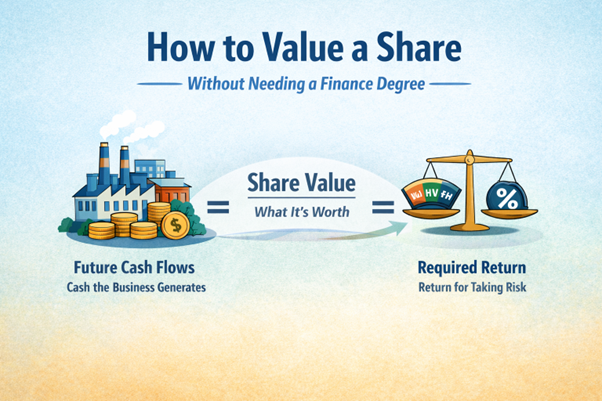
When you buy a share on the stockmarket, you are buying a small slice of a real business.
And a business is worth something for one reason: it can produce cash for its owners over time which is either paid out as dividends or reinvested to grow future cash.
The market gives you a share price every day. Valuation is your attempt to estimate what that business is worth, based on how much cash it can generate for owners and what return investors require for taking the risk of owning it.
The following valuation methodology and logic applies to shares, bonds, property, and most financial assets:
Value today = the future cash you expect to receive, discounted back at the return you require.
These two inputs that drive valuation are:
Future cash flows - How much cash the business is likely to generate for owners over time. Because of inflation, future cash is less valuable than cash today, so you discount it back (example below).
The required return - The return investors (you!) demand to own that business, given its risk. The riskier the business, the higher the return you require.
Higher risk → investors require a higher return.
Higher required return → investors are willing to pay less today for the same future cash.
Here is a simple example. If you expect $100 in one year:
Required return 10% → value today ≈ $100 / 1.10 = $90.91
Required return 20% → value today ≈ $100 / 1.20 = $83.33
Same $100 in 12 months’ time. Different required return. Different value today.
Simple idea. Big implications.
Why share prices move around so much
Share prices move for two broad reasons:
1. The business outlook changes for profits, competition, costs, and growth prospects.
When earnings expectations improve or new opportunities arise, expected future cash flows increase. Values rise. Prices rise.
When profit expectations decline or operating pressures emerge due to things like higher inflation or regional conflict, expected future cash flows decrease. Values fall. Prices fall.
This is why diversification is crucial – it allows investors to benefit from positive developments across multiple companies while mitigating the impact of any single company’s setbacks. Think of recent one day falls in listed stocks like Cochlear (-40%) and CSL (-16%). These are blue chip stocks many investors (wrongfully) consider low risk.
2. Investor confidence changes as fear and optimism move oscillate, which impacts the required return (up or down) we as investors demand.
In calm markets, investors accept a lower required return because of less uncertainty. Values rise. Prices rise.
In stressed markets, investors demand a higher required return because we become uncertain about the economic outlook for businesses. Values fall. Prices fall.
Sometimes the business hasn’t changed much at all — the “sentiment” or “mood” has.
Think back to 2008 and the GFC - the main reason share prices fell was because of huge uncertainty how the issues in the US banking system would play out. Investors quickly required a much, much higher return for dealing with the uncertainty of holding stocks. Consequently, prices fell sharply but the expected return went up significantly!
Worked Example (fictional company)
To help understand the maths, here are four scenarios for a fictional company with:
cash flows expected over the next five years,
an estimate of value for “all the years after that” (often the biggest piece), and
1,000,000 shares on issue.
The takeaway is how sensitive value can be to small changes in assumptions.
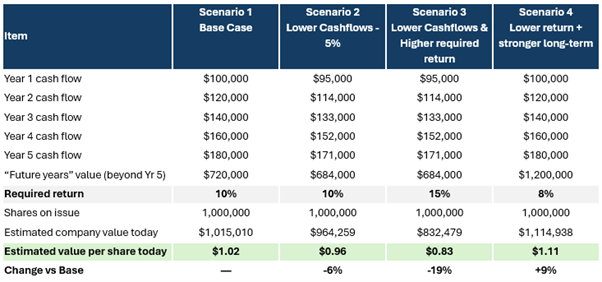
Scenario 1 - Base Case (nothing dramatic)
Cash flows look healthy and rising.
Investors want a reasonable 10% return for the risk.
A big part of value comes from the long-term (“future years”) component.
Estimated value lands around $1.02 per share.
Scenario 2 - Cashflow Expectations Fall ~5%
The business is expected to generate a bit less cash each year.
Long-term value also slips (a softer outlook tends to echo into the future).
Investor confidence hasn’t changed — required return stays at 10%.
Value falls to about $0.96 per share.
Scenario 3 - Same Cash Flows as Scenario 2, Investors Get More Nervous (sentiment does the damage)
The business outlook is unchanged from Scenario 2.
But investors now want 15% instead of 10% to take the risk.
That higher required return lowers today’s value — especially for long-dated cash flows.
Value drops further to about $0.83 per share.
Scenario 4 - Lower Required Return + Stronger Long-Term Value (confidence + optimism)
Near-term cash flows look like the base case again.
The big lift is the long-term component — the business is assumed to be more valuable beyond year 5.
Investors are calmer and accept an 8% required return.
Value rises to about $1.11 per share.
Do Market Highs mean I should sell?
When prices rise a lot, future returns from that point could be lower because you’re paying more today for the same future cash. When markets are high, some may ask whether it is a good time to sell and wait to buy back into the market once prices fall?
Humans are conditioned to think that after the rise must come the fall, tempting us to fiddle with our portfolios. But the data suggest such signals only exist in our imagination and investors should treat record highs with indifference.
In looking at all 1,000-plus monthly closing levels between 1926 and 2022 for the S&P 500 Index, 30% of the monthly observations were new market highs. If stocks have a positive expected return, reaching record highs with some frequency is exactly the outcome we would expect.
After those highs, the average annualised compound returns ranged from almost +14% one year later to more than +10% pa over the next five years, as this graphic shows:
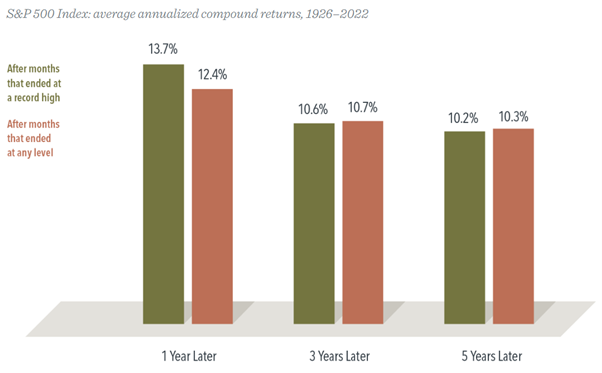
Source: Dimensional Fund Advisors
These results were close to average returns over any given period of the same length. When viewed in terms of the index simply having risen or fallen, the S&P 500 was higher a year after notching a record 81% of the time, and 86% of the time after five years.
This data tells us the system is working just as we would expect – nothing more. So don’t let market highs deter you from investing. As Warren Buffett said, “Our biggest mistakes were things we didn't do - companies we didn't buy that we knew were wonderful businesses, but we hesitated on”.
Investors are punished more severely for the decisions they don’t make than the decisions they make.
How this aligns with Lorica’s investment approach
At Lorica, we focus less on heroic predictions and more on a disciplined process:
Diversification to avoid relying on any single outcome
Consistency so decisions aren’t driven by headlines
Rebalancing to maintain risk and improve decision quality over time
Humility about what we can and can’t forecast
Summary
A share is ultimately worth the future cash a business can generate, adjusted for the return investors require.
And because investor confidence changes, share prices can swing sharply - sometimes far more than the business itself deserves.
When prices fall, it means the expected return has gone up. This means it is a great time to buy rather than sell!
A sound strategy is built for that reality. Follow the process, rebalance when appropriate, stay diversified… and get on with enjoying your life while the portfolio does its job.
Author: Rick Walker